Hollow North–South
80% interest
Copper and gold exploration in the Yerington Copper District.
Location
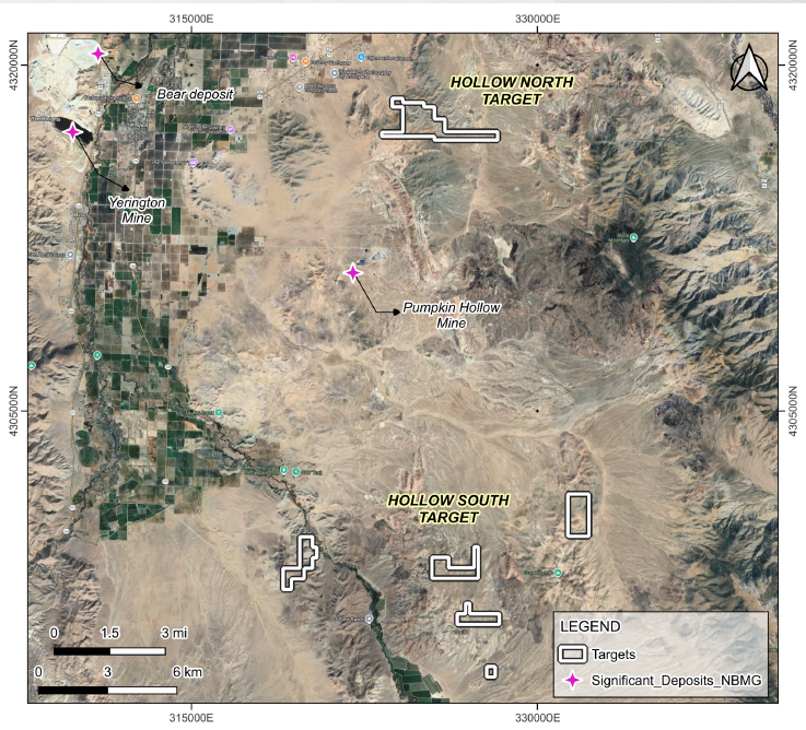
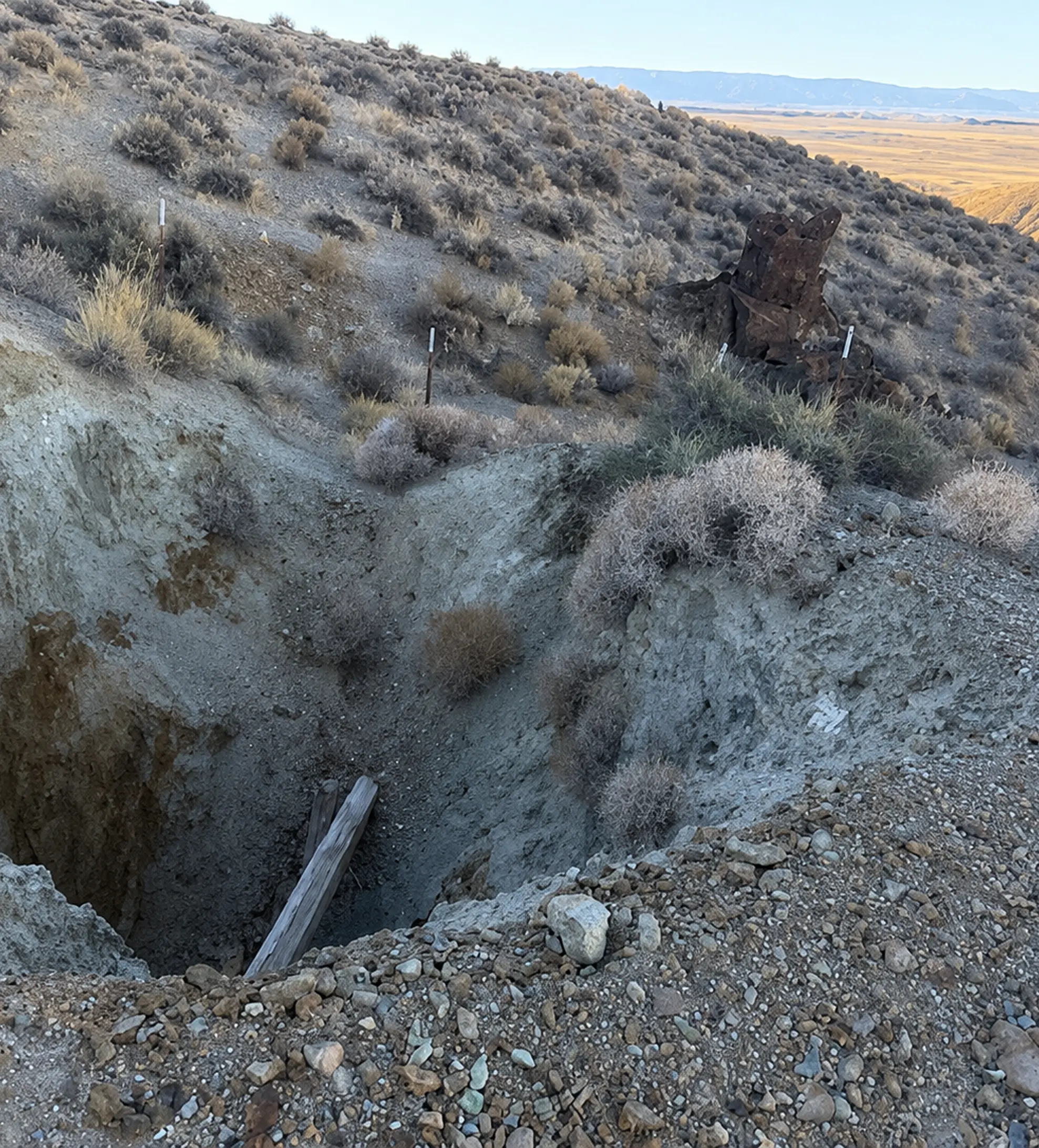
The Hollow North–South property is located 15 km east of Yerington, ~100 km south of Reno, Nevada. It is situated on 109 claims on BLM land, in the Yerington Copper District, an established jurisdiction with world-class deposits. The project consists of 2 areas, Hollow North and Hollow South.
Target
IOCG Cu-Au / Porphyry Cu-Au / Epithermal Au
Geology
The property is underlain by Triassic to Jurassic volcanics and marine sediments intruded by Jurassic – Cretaceous age diorite to monzonite intrusive. This includes the intrusion of the Jurassic age mineralized Yerington Batholith.
The Yerington Batholith is interpreted to be the source of numerous large copper-gold deposits in the district including Yerington, Ann Mason, Bear, MacArthur and Pumpkin Hollow mine. The historical NI 43-101 Technical Report for Nevada Copper Corp., effective January 21, 2019, reported open-pit Proven and Probable Mineral Reserves at Pumpkin Hollow of approximately 386 million short tons at 0.47% Cu, 0.002 oz/st Au and 0.055 oz/st Ag. The Company has no interest in or rights to any of these deposits. The Qualified Person has been unable to verify the information regarding these deposits, and mineralization on adjacent or nearby properties is not necessarily indicative of mineralization on the Hollow North–South property.
Mineralisation
Hollow North target
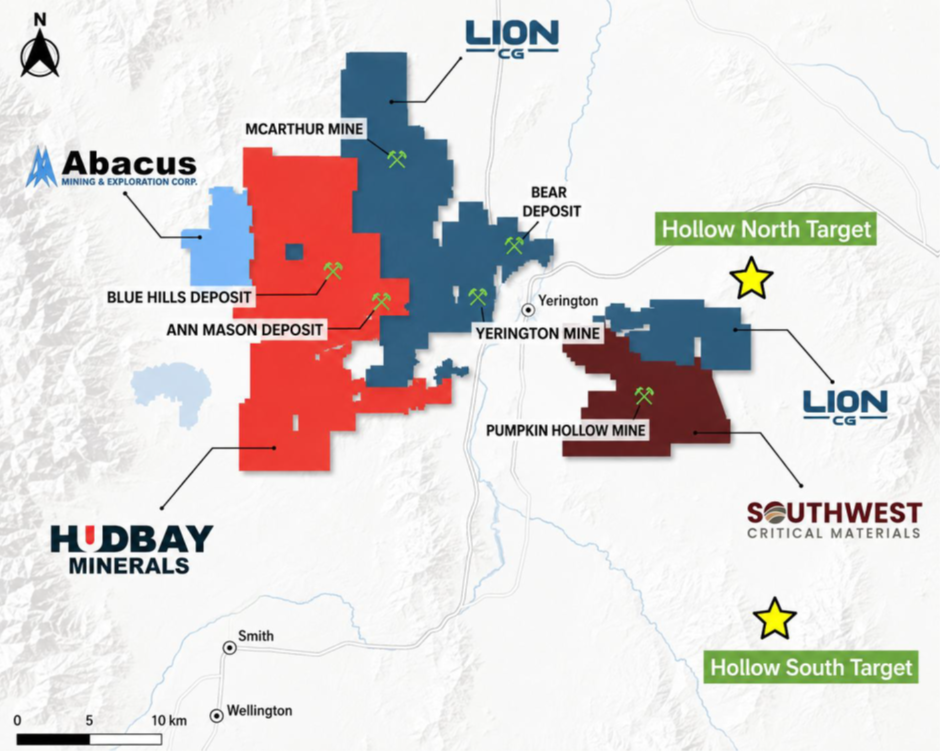
Mineralisation is defined by shear-hosted quartz-sulphide structures within a diorite-monzonite intrusive complex. Historical rock chip values including 7.38% Cu and 6.84% Cu were reported (NV Resources Internal Memo, March 2026). These historical results have not been verified by the Company. Mineralisation is hosted in 10–50 cm quartz-sulphide veins, within 1–10 m wide shear zones. These shear zone rocks are altered to sericite-chlorite-pyrite and stained by limonite and malachite.
Geophysical signature
Coincides with a magnetic high anomaly like Pumpkin Hollow Mine, suggesting a genetic link to the mineralised Yerington Jurassic Batholith. The presence of a magnetic anomaly does not indicate that the property hosts mineralization similar to that at Pumpkin Hollow or other deposits in the district.
Exploration implications
Regional exploration has used magnetic surveys and drilling to investigate covered targets.
Hollow South target
A 1,400 m x 800 m zone of porphyry-style stockwork quartz sulfide mineralization has been identified, within a host diorite. Malachite staining occurs along fractures indicating the presence of copper mineralization.
In another part of the Hollow South target area, historic rock chip sampling identified 10–30 cm gold-bearing quartz veins, with reported results including 19.70 g/t Au and 15.6 g/t Au (NV Resources Internal Memo, March 2026). These historical results have not been verified by the Company. Rock samples are selective by nature and are not necessarily representative of the mineralization of the property.
Hydrothermal alteration, iron oxidation, and Cu-Au geochemical anomalies are indicated in historic rock and soil sample results (NV Resources Internal Memo, March 2026). These historical results have not been verified by the Company. Rock samples are selective by nature and are not necessarily representative of the mineralization of the property.